






There are five core airport planning documents every airport team should understand: the Master Plan, the Strategic Plan, the Business Plan, the Capital Improvement Plan, and the Airport Emergency Plan. Most airports have at least one of them. Very few have all five. And almost none have their airport planning documents pointing in the same direction.
That gap creates a specific kind of frustration. You have a thick Master Plan on the shelf. Your CIP is filed with the FAA. But the day-to-day reality of running your airport, aligning your board, keeping tenants engaged, executing on priorities, feels disconnected from any of it. The documents exist. The execution does not.
This post breaks down what each airport planning document actually does, what it does not do, and how to figure out which one your airport is missing.
Key Takeaways
- Most general aviation airports have a Master Plan (94%), but fewer than 55% have a Strategic Plan and only about 25% have a formal Business Plan, according to research from the National Academies of Sciences.
- A Master Plan defines what facilities to build over 20 years. It does not tell you how to lead the organization building them.
- The Strategic Plan is the most commonly missing document at GA airports, and its absence is the most common reason long-range plans stall at the execution level.
- The Capital Improvement Plan (CIP) funds specific projects. It is not a management system.
- The Airport Emergency Plan (AEP) is required by the FAA under 14 CFR Part 139 for certificated airports. It is a compliance and safety document, not an operational strategy.
- Having a plan and executing a plan are two different things. The documents in your filing cabinet only create value when someone is actively working them.
Why the Confusion Exists
These five planning documents did not grow up together. Each one was developed in response to a different pressure.
The Master Plan exists because the FAA needs airports to demonstrate long-range facility thinking before awarding development grants. The CIP exists to program those grants into funded projects. The AEP exists because Part 139 certification requires it. The Business Plan and Strategic Plan exist because airport managers and boards eventually realize that compliance documents do not run an airport.
The result is a filing cabinet full of documents that were built separately, at different times, often by different consultants, for different audiences. Nobody designed them as a system. Most airports have never sat down and asked: Do these documents actually talk to each other?
That question matters more than most teams realize.
At a Glance: The 5 Airport Planning Documents
Before the detailed breakdowns, here is a quick-reference comparison:
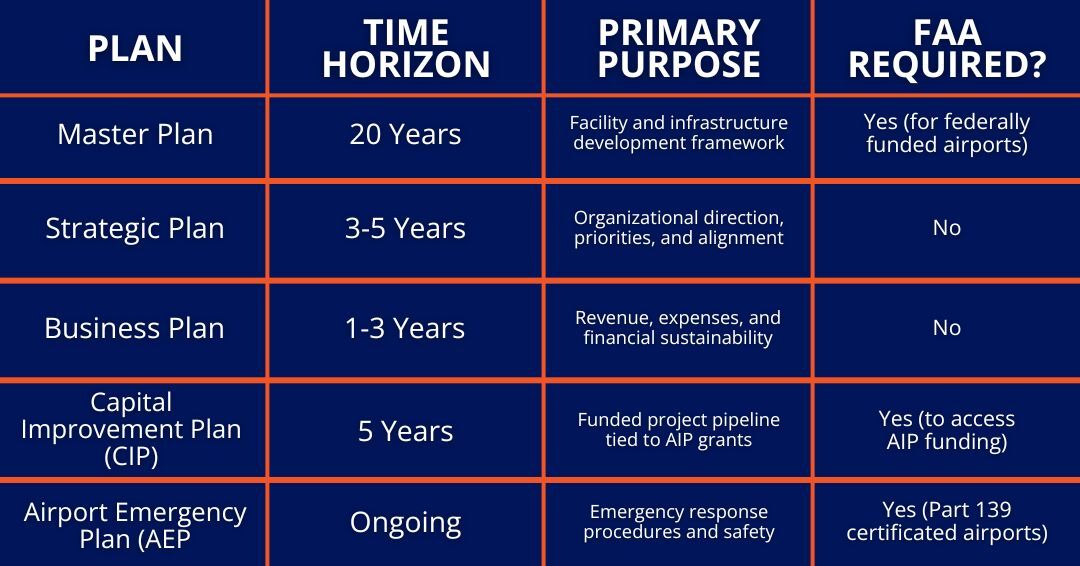
The 5 Airport Planning Documents
Here is what each document is, what it covers, and where it stops.
1. The Master Plan
An airport Master Plan is a 20-year facility and infrastructure framework that guides runway, taxiway, hangar, and terminal development for your airport.
What it is: The long-range framework for facility development and infrastructure. A Master Plan assesses your airport’s current capacity, forecasts demand over 5, 10, and 20 years, identifies gaps, and lays out a development strategy to meet future needs.
Time horizon: 20 years (reviewed every 10 years)
Who produces it: Aviation planning consultants or engineering firms, working with the airport sponsor and the FAA.
Its key deliverable: The Airport Layout Plan (ALP), a drawing set that depicts existing facilities and proposed developments. Airports that receive federal funding are required to keep the ALP current.
What it does for you: It gives you the facility framework. It tells you what runways, taxiways, hangars, terminals, and support infrastructure you will need, and roughly when. It satisfies FAA planning requirements and supports your grant applications.
What it does NOT do: It does not tell you how to run the organization. It does not address leadership, culture, tenant relations, staffing, or day-to-day execution. You can have a perfect Master Plan and still have a dysfunctional team, a shrinking tenant base, and a board that cannot agree on priorities.
2. The Strategic Plan
An airport Strategic Plan is a 3-to-5-year organizational direction framework that sets priorities, aligns leadership, and defines what success looks like for the airport as a business and a community asset.
What it is: The organizational direction and priority framework. A Strategic Plan sets goals, defines what success looks like for your airport, and creates accountability for moving toward that vision.
Time horizon: 3 to 5 years
Who produces it: Developed with airport leadership, board members, and key stakeholders. Often facilitated by a business consultant or strategic planning firm.
What it does for you: It tells you where the organization is going and why. It aligns your board, your staff, and your tenants around shared priorities. It gives you a way to evaluate decisions: does this project, hire, or investment move us toward the goal or away from it?
What it does NOT do: It does not satisfy FAA planning requirements or specify facility development. A Strategic Plan without a Master Plan leaves you with direction but no infrastructure roadmap.
The most common confusion we see is airport teams treating the Master Plan as the airport’s strategic plan. They are not the same document, and using one as a substitute for the other is how execution stalls.
The hard truth: According to research from the National Academies of Sciences, fewer than 55% of general aviation airports have a Strategic Plan. That means nearly half of all GA airports are making long-range decisions without an organizational framework to guide them.
3. The Business Plan
An airport Business Plan is the operational and financial framework that examines revenue sources, operating costs, and financial sustainability, typically across a one-to-three-year horizon.
What it is: The operational and financial framework. An airport Business Plan addresses revenue sources, operating expenses, service offerings, pricing, and financial sustainability.
Time horizon: 1 year (sometimes 3 to 5 years for major revenue initiatives)
Who produces it: Airport management, sometimes with support from a business consultant or financial advisor.
What it does for you: It tells you how the money works. It forces you to examine whether your current revenue streams can sustain your operation, where the growth opportunities are, and what you need to change to stay financially healthy.
What it does NOT do: It does not address long-range infrastructure needs, organizational culture, or community relationships. A Business Plan answers “can we pay the bills?” It does not answer “where are we going?”
The hard truth: The same National Academies research found that only about 25% of GA airports have a formal Business Plan. The number may actually be lower. Many airports have a budget, but a budget is not a Business Plan.
4. The Capital Improvement Plan (CIP)
An airport Capital Improvement Plan (CIP) is a five-year funded project pipeline that identifies specific improvement projects, their costs, and their funding sources, typically tied to FAA Airport Improvement Program grants.
What it is: The funded project pipeline. A CIP identifies specific improvement projects, their estimated costs, their funding sources, and their implementation timeline, typically over five years.
Time horizon: 5 years (updated annually)
Who produces it: Airport management and sponsor, usually with input from the Master Plan and the FAA’s Airport Improvement Program (AIP) process.
What it does for you: It translates long-range planning intentions into specific, funded projects. It is the document that connects your Master Plan to actual construction. It is also what the FAA reviews when evaluating your eligibility for AIP grant funding.
What it does NOT do: It does not execute itself. A CIP is a list of funded intentions. The projects in it still require leadership, procurement, contractor management, tenant communication, and board oversight to actually happen. None of that is in the CIP.
5. The Airport Emergency Plan (AEP)
An Airport Emergency Plan (AEP) is the safety and emergency response framework that documents procedures, roles, and responsibilities for managing aircraft accidents, security threats, and other emergencies at your airport.
What it is: The safety and emergency response framework. An AEP documents the procedures, roles, and responsibilities that activate when something goes seriously wrong at your airport: an aircraft accident, a bomb threat, a severe weather event, or a fuel spill.
Time horizon: Ongoing (reviewed and exercised regularly)
Who produces it: Airport operations staff, in coordination with local emergency services, the TSA, and other agencies. Governed by FAA Advisory Circular 150/5200-31C.
What it does for you: It keeps people alive when something goes wrong. For Part 139 certificated airports, it is also a regulatory requirement. A well-exercised AEP means your team knows exactly what to do under pressure, before the pressure arrives.
What it does NOT do: It is not a leadership document or an operational strategy. It does not address daily performance, revenue, or organizational direction. The AEP is your safety net. Every airport needs one. But it is not a substitute for any of the other four plans.
The Gap Nobody Talks About

Here is the problem: Your Master Plan tells you what facilities to build over 20 years. Your CIP tells you what you can fund in the next five. Your AEP tells you what to do when something goes wrong. Your Business Plan tells you how the money works.
None of those documents tell you how to lead the people who have to execute all of it. None of them align your board and your staff around shared priorities. None of them translate a 20-year vision into the decisions you have to make this quarter.
That is what a Strategic Plan is supposed to do. And it is the document most airports do not have.
The absence shows up in familiar ways. Long-range plans sit on shelves. Board meetings turn into debates about priorities that were never formally agreed on. Good projects stall because nobody owns the execution. Staff and tenants lose confidence in leadership because the direction keeps shifting.
Having a Master Plan is not the same as having a strategy. That sentence is worth printing and putting on the wall.
Which Airport Planning Document Does Your Airport Actually Need?
If any of these sound familiar, here is a starting point for your diagnosis.
“We have a Master Plan but nothing is getting executed.” You likely have a facility framework without an organizational strategy to drive it. The missing piece is a Strategic Plan that connects the long-range vision to the decisions and actions of the people responsible for running the airport day-to-day.
“We do not know where our revenue will come from in three years.” You need a Business Plan. You may have a budget, but a budget is not a strategy for financial sustainability. A Business Plan examines your revenue model, your cost structure, and your growth opportunities.
“Our Master Plan is more than 10 years old.” The FAA recommends reviewing Master Plans every 10 years. If yours is older than that, your airport planning documents may no longer reflect your actual capacity, demand, or development priorities. An update is likely overdue.
“Our board and staff are not aligned on what matters most.” This is not a facility planning problem. It is a strategic planning and leadership problem. No Master Plan or CIP will fix misalignment at the organizational level. That requires deliberate work: setting shared goals, creating accountability structures, and building the kind of leadership culture that executes consistently.
“We have an AEP but nobody has exercised it in years.” An AEP that has never been tested is only slightly better than no AEP at all. Regular tabletop exercises and drills are not optional. They are what transforms a document into a practiced response.
How the Plans Work Together (When They Do)
In a well-run airport system, the five plans form a hierarchy.
The Strategic Plan sets organizational direction. It answers: who are we, where are we going, and what matters most?
The Master Plan aligns facility development to that direction. It answers: what do we need to build, and in what sequence, to support where we are going?
The CIP funds the specific projects that execute the Master Plan. It answers: which projects are we doing in the next five years, and where is the money coming from?
The Business Plan keeps the operation financially sustainable while all of it is happening. It answers: how do we stay solvent and continue to grow?
The AEP keeps everyone safe throughout. It answers: What do we do when something goes wrong?
In practice, most airports did not build these documents as a system. They built them reactively, in response to different pressures, often years apart. The documents frequently point in different directions, use different assumptions, and sit in different filing cabinets managed by different people.
Getting them aligned is not a documentation project. It is a leadership project.
Frequently Asked Questions
What is the difference between an airport master plan and a strategic plan?
A Master Plan is a facility and infrastructure framework, typically covering 20 years, that guides runway, taxiway, hangar, and terminal development. A Strategic Plan is an organizational direction framework, typically covering 3 to 5 years, that sets goals, aligns stakeholders, and defines how the airport will operate and grow as an organization. The two documents serve different purposes and should complement each other, with the Strategic Plan informing the priorities the Master Plan builds toward.
How often should an airport master plan be updated?
Airport Master Plans should be reviewed every 10 years, according to standard FAA guidance. However, significant changes in aviation activity, community development, or funding availability may warrant an earlier update. Airports that receive federal funding under the Airport Improvement Program (AIP) are required to maintain a current, FAA-approved Airport Layout Plan (ALP), which is the primary deliverable of the Master Plan process.
Is an Airport Emergency Plan required by the FAA?
Yes. Under 14 CFR Part 139, all FAA-certificated airports are required to maintain an Airport Emergency Plan (AEP). The AEP must meet the standards in FAA Advisory Circular 150/5200-31C. It covers emergency response procedures for aircraft accidents, bomb threats, natural disasters, hazardous material incidents, and other emergencies. Regular exercises and drills are also expected to ensure staff and partner agencies can execute the plan under real conditions.
What does a Capital Improvement Plan include for an airport?
An airport Capital Improvement Plan (CIP) identifies specific improvement projects, their estimated costs, their funding sources, and their implementation timeline, usually across a five-year horizon. Projects typically include airfield improvements, building construction or renovation, equipment, and safety upgrades. The CIP feeds directly into the FAA’s Airport Improvement Program (AIP) grant process and is updated annually to reflect completed projects, new needs, and available funding.
Why do so many airports have a Master Plan but no Strategic Plan?
The Master Plan is required to access federal development funding, so most airports produce one early and update it periodically. The Strategic Plan is not required by any regulatory body, so it often gets skipped. The result is that airports know what they need to build over 20 years but have no formal framework for how the organization will operate, make decisions, or align its leadership during that time. That gap is one of the most common root causes of stalled execution at the airport level.
The Document in the Filing Cabinet Does Not Run Your Airport
You can have every planning document on the list and still be struggling to execute. The filing cabinet is not the problem. The gap between documentation and direction is.
Most airports that come to us have a Master Plan. Some have a CIP. Very few have a Strategic Plan that anyone is actively working. And almost none have all five airport planning documents built to work together.
Aegis360’s approach to aviation consulting services starts with a simple question: What does your airport actually need right now, and what is standing between where you are and where you want to be? For some airports, that is a Master Plan update. For most, it is a strategic planning and execution framework that connects the long-range vision to the decisions happening every week.
If you are an airport manager, director of aviation, or authority board member trying to make sense of your planning documents or trying to figure out what is missing, we are glad to have that conversation. Reach out to the Aegis360 team through our aviation consulting services page and let us know where you are starting from.