



People sit through a workshop, take a few notes, and then return to the same pressure, the same silos, and the same tradeoffs with no safe way to practice decisions before they matter.
That’s why Aegis360 uses Table Top Business Simulations: facilitator-led experiences that put real decision-making in motion.
Instead of passively absorbing information, your team runs through realistic business scenarios, makes real-time decisions, and watches outcomes unfold, all in a controlled environment. The result is faster learning, better judgment, and stronger alignment across roles.
Here are five benefits that make Table Top Business Simulations one of the most effective team training formats available.
What is a Table Top Business Simulation?
A Table Top Business Simulation is a facilitator-led training experience where a team works through a realistic business scenario, makes decisions at key moments, and then sees how those decisions impact results over a compressed timeline.
It’s practical by design:
- Decisions create outcomes
- Outcomes create discussion
- Discussion creates real behavior change
That’s why this format consistently beats “information-only” training when the goal is better performance, not just better understanding.
Benefit 1: Measurable Impact You Can Tie to ROI
When training is purely lecture-based, it’s hard to prove what changed and even harder to prove the change stuck.
Table Top Business Simulations are different because you can measure learning and behavior in a structured way.
A strong program gives you:
- Clear objectives before the session (what we want to improve)
- Observable decision patterns during the simulation (how teams think under pressure)
- A debrief that translates learning into action (what changes Monday morning)
- Follow-up checkpoints that connect training to outcomes (what moved after 30–90 days)
How teams measure it: Many organizations map simulations to the Kirkpatrick model (reaction → learning → behavior → results) and attach results to KPIs that matter: productivity, cycle time, quality, customer outcomes, operational consistency, or sales performance.
Benefit 2: Faster Leadership Development Under Real Constraints
Leadership development often fails because it stays in theory.
Table Top Business Simulations push leadership into practice quickly.
Inside the simulation, people have to:
- Make decisions with incomplete information
- Balance short-term wins with long-term consequences
- Communicate clearly under pressure
Work through disagreement without breaking alignment - Adapt when conditions change
It’s one thing to talk about strategic thinking. It’s another to watch how someone actually thinks when the “market” shifts, resources tighten, or priorities collide.
And because it’s facilitated, teams don’t just “play the game.” They leave with the insight behind their decisions and a clearer understanding of what effective leadership looks like inside your organization.
Benefit 3: Better Engagement Than Traditional Corporate Training

Most employees can spot “checkbox training” from a mile away.
Table Top Business Simulations earn attention because participants aren’t watching; they’re responsible.
Why engagement is naturally higher:
- Active decision-making: Teams are constantly choosing, prioritizing, and responding
- Real collaboration: People have to align across roles and perspectives
- Immediate feedback: Decisions produce visible outcomes without waiting weeks
- Healthy urgency: A timeline creates focus without real-world consequences
When people are engaged, they remember more, and more importantly, they apply more. That’s the difference between “interesting training” and “training that actually changes performance.”
Benefit 4: A Safe Environment to Learn From Failure
In real business, failure is expensive. It costs time, money, customer trust, morale, and sometimes careers.
That reality makes people cautious. And caution often blocks learning.
A Table Top Business Simulation creates a low-risk environment where teams can:
- Test strategies they wouldn’t normally try
- See what breaks without damaging the business
- Learn faster because mistakes are allowed
- Develop resilience and confidence for high-pressure situations
This is especially valuable when you’re training for situations where judgment matters most: change management, decision tradeoffs, resource constraints, cross-functional planning, and operational complexity.
When teams experience consequences in a simulation, they tend to spot patterns sooner — and avoid the same mistakes when the stakes are real.
Benefit 5: Big-Picture Understanding Across the Business
Many teams operate inside functional silos. People can be excellent at their role while still missing how their decisions affect the organization downstream.
Table Top Business Simulations break that pattern.
In a well-designed simulation, participants see:
- How one department’s choices create pressure in another
- How short-term decisions can create long-term problems
- How incentives and metrics shape behavior
- How execution depends on cross-functional clarity
This “systems thinking” is hard to teach in a slide deck, but it becomes obvious when people feel the ripple effects in real time.
For mid-level leaders and specialists, this benefit alone can create a major shift: fewer handoff issues, better prioritization, and stronger alignment across teams.
How Do Table Top Business Simulations Work?
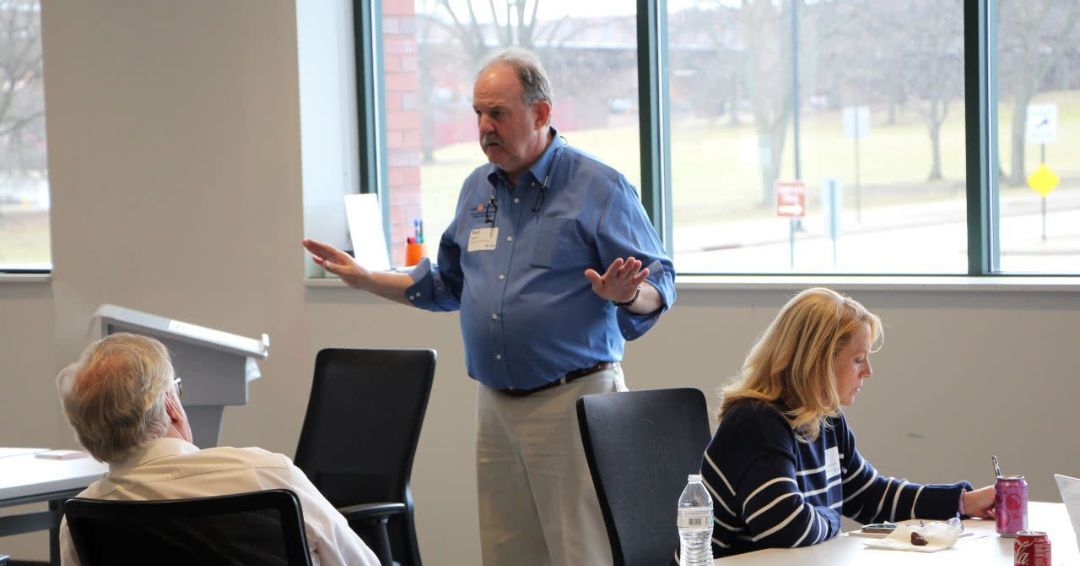
A Table Top Business Simulation is typically structured around a realistic scenario with decision rounds that force tradeoffs. The facilitator introduces new conditions throughout the session, such as constraints, surprises, shifting priorities, or market changes, and teams respond based on their assigned roles.
The facilitator’s job is to:
- Keep the experience moving
- Prompt discussion when teams get stuck
- Surface decision patterns (good and bad)
- Connect what happens in the room to what happens at work
A well-run simulation always includes a debrief, because that’s where insight turns into behavior change.
Typical Session Timeline
- Pre-session (1–2 weeks): goals, participant context, scenario tailoring
- Simulation day (4–8 hours): decision rounds, team collaboration, live outcomes
- Debrief (1–2 hours): key insights + action planning
- Follow-up (30–90 days): reinforcement + measurement checkpoints
FAQ: Table Top Business Simulations
- What are Table Top Business Simulations?
Table Top Business Simulations are facilitator-led, role-based training experiences where teams work through realistic business scenarios, make decisions, and see how those decisions affect outcomes over a compressed timeline. They can be in-person or virtual. - How are Table Top Business Simulations different from tabletop exercises?
A tabletop exercise typically tests a plan or response (often tied to incident readiness, compliance, or risk). A table top business simulation focuses on building better business judgment, strategy, operations, leadership tradeoffs, and cross-functional decision-making.
- What skills do Table Top Business Simulations improve most?
Teams commonly strengthen strategic thinking, communication, collaboration, leadership under pressure, prioritization, and cross-functional awareness. Because outcomes are visible immediately, participants also develop faster pattern recognition and better judgment.
- How do you measure ROI from a Table Top Business Simulation?
ROI can be measured using a framework like the Kirkpatrick model and mapped to KPIs such as productivity, quality, cycle time, customer outcomes, sales performance, or error reduction. The best programs set baseline expectations before the session and follow up 30–90 days later to measure behavior change.
- How long does a Table Top Business Simulation take, and what do we need to run one?
Most sessions run 4–8 hours, plus a short pre-session assessment and a structured debrief. You’ll typically need a facilitator, role assignments, a scenario aligned to your goals, and time for action planning so the learning transfers into day-to-day work.