




You know the feeling: your inbox overflows, three people need decisions now, the project deadline moved up, and your phone keeps buzzing.
At Aegis 360 Consulting, we work with business owners and managers who face this reality every day. The pressure to do it all creates a trap where you move fast but get nowhere, working hard but seeing little progress. The problem isn’t your effort; it’s how you choose what matters.
Key Takeaways
- Teams that prioritize effectively are 1.4 times more likely to outperform their peers, showing a direct link between prioritization skills and competitive advantage
- Companies selecting fewer priority initiatives are 16% more likely to be top-tier performers than those with many or no clear priorities
- After a disruption, it takes over 20 minutes to return to your original task, making poor prioritization extremely costly
- 68% of employees feel they lack sufficient time to complete their tasks, often due to unclear priorities
- Decision fatigue causes leaders to rely on mental shortcuts rather than thoughtful analysis, resulting in misaligned decisions
Knowing how to prioritize under pressure isn’t a personality trait—it’s a learnable skill. Here’s what gets in the way, and how to fix it.
The Real Cost of Poor Prioritization
Poor prioritization doesn’t just slow you down; it costs you money and momentum.
Research shows that teams that prioritize effectively are 1.4 times more likely to outperform their peers. Companies that select fewer priority initiatives are 16 percent more likely to be in the top tier of their industry.
The numbers tell a clear story: when you try to do everything, you accomplish less. When priorities stay fuzzy, your team spins, and when accountability drops, follow-through disappears.
Knowledge workers spend an average of 1.8 hours per day on activities that could be eliminated, which adds up to nine weeks per year of wasted effort.
Your team feels it too. When priorities aren’t clear, people struggle to complete what actually matters. The real issue isn’t time—it’s focus.
Why Everything Feels Urgent
You face competing demands from every direction. Your customers want faster service, your team needs guidance, your board expects results, and your operations need attention.
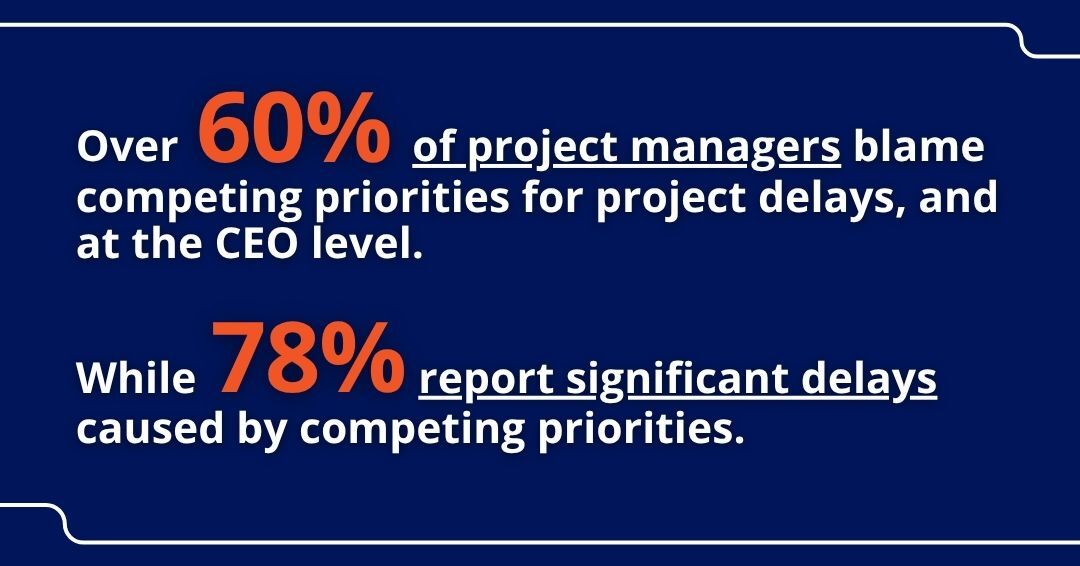
Research shows that competing priorities are among the leading causes of project delays, with over 60% of project managers citing them as a primary culprit and nearly 78% of CEOs reporting significant delays as a result.
The volume of decisions compounds the problem, as leaders make dozens of decisions daily, and during times of change, that number increases exponentially, with each decision requiring follow-up decisions.
Decision fatigue sets in when you make too many decisions without a clear framework, causing you to rely on mental shortcuts, become more impulsive, and drift away from your long-term objectives.
This is where most leaders get stuck. They know they need to prioritize, but they don’t know how to do it when everything screams for attention.
How to Prioritize: A Three-Question Framework
Good prioritization starts with three questions:
What business are you in? This sounds simple, but most leaders skip it, assuming everyone knows the answer. When you ask your team this question, though, you get different answers.
Alignment starts here—when your team looks in the same direction, prioritization becomes easier.
What do you sell versus what do your customers buy? You might sell software, but your customers buy time savings. You might sell consulting, but your customers buy clarity and results.
This gap matters because when you understand what customers actually buy, you can prioritize the work that delivers that value.
What moves you toward your purpose? Purpose gives you a filter where every request, every project, and every decision gets measured against it.
Does this move us toward our purpose or away from it? Does this align with what our customers buy, or does it just keep us busy?
How to Prioritize Under Pressure
- Name what is actually urgent.
Urgent means it has a real deadline with real consequences—most things that feel urgent are just loud.
Ask yourself: What happens if this waits until tomorrow? What happens if this waits until next week?
You’ll find that many urgent items can wait, and the ones that cannot wait become clear.
- Build accountability mechanisms.
Accountability keeps priorities from drifting, and when you assign clear owners to each priority, follow-through improves.
Set a regular cadence for checking progress—weekly works for most teams, though some priorities need daily check-ins. The cadence matters less than the consistency.
- Limit your active priorities.
Research from PMI shows that 20% of projects in a typical portfolio are so badly aligned with business goals that they should stop.
You cannot do everything well, and when you spread your focus across too many priorities, all of them suffer.
Pick three to five priorities for the quarter—no more. When something new comes up, decide what drops off the list.
- Practice decision-making in low-stakes environments.
Decision-making improves through practice, but you cannot practice on your actual business without risk.
This is where simulation becomes valuable—you compress years of experience into hours, see the consequences of your choices, and build the muscle memory for better decisions.
How Can You Build Better Prioritization Skills?
At Aegis 360, we use two programs to help leaders build better prioritization and decision-making skills.
Boat Burner is a productivity app that helps you prioritize your to-do list using a proprietary decision-making process. The app allows you to use any criteria for selecting what you’ll tackle first, second, and third—cutting through the noise of competing demands.
Once you’ve prioritized your list, you “burn the boat” by committing to work on the first item until it’s done, even if you get interrupted. This disciplined approach prevents you from bouncing between tasks and losing focus.
Teams that use Boat Burner develop consistency in their prioritization approach, building the discipline to complete what matters most rather than constantly reacting to whatever feels loudest in the moment.
Celemi Decision Base™ is an immersive, team-based business simulation where participants manage a fictional company, making critical decisions across key business areas like finance, operations, and strategy. Teams compete to grow their business while learning how their choices impact profitability, cash flow, and long-term sustainability.
Through hands-on learning in Decision Base, leaders develop financial acumen and strategic thinking skills, practicing the kind of high-stakes decision-making they’ll face in real business situations—but without the risk to their actual operations.
Building a Culture of Clear Priorities
Prioritization isn’t just a personal skill—it’s an organizational capability.
Firms with high organizational cohesion are 2.3 times more likely to be in the top quartile of healthy, high-performing organizations, and that cohesion comes from alignment on priorities.
When your leadership team agrees on what matters, that clarity flows down, enabling your managers to make better decisions and your frontline teams to know where to focus their energy.
Change programs that emphasize effective prioritization are 1.7 times more likely to achieve positive performance changes and sustain those gains, making the pattern clear.
Organizations that prioritize well perform better, waste less time, deliver more value, and build stronger teams.
How Do You Know Prioritization is Working?
When you know how to prioritize effectively, the signals are easy to spot.

Good prioritization creates space to think, execute, and deliver results that matter.
It doesn’t eliminate pressure, but it channels pressure toward the work that moves your business forward.
Frequently Asked Questions
How do I prioritize when my boss keeps adding urgent tasks?
Ask your boss to help you prioritize by showing them your current list and asking which item should move down when the new task comes in. This creates a conversation about trade-offs instead of just adding to your pile.
What if everything really is urgent?
If everything is urgent, nothing is urgent. Step back and ask what happens if each item waits 24 hours—the truly urgent items will become clear, and the rest can follow a normal priority sequence.
How often should I review my priorities?
Review weekly at a minimum, though some leaders review daily. The key is consistency, because when priorities shift without a regular review process, teams lose alignment and waste effort on work that no longer matters.
Take the Next Step
Prioritization starts with clarity about your business, your customers, and your purpose, but building that clarity across your organization takes the right support.
At Aegis 360® Consulting, we help businesses develop strategic clarity and build leadership teams that make better decisions under pressure. Through business coaching, leadership development programs, and hands-on training simulations like Boat Burner and Decision Base, we equip your team with the frameworks and skills to prioritize what matters.
Contact Aegis 360 Consulting to discover how we can help your team cut through the noise and focus on what drives results.